
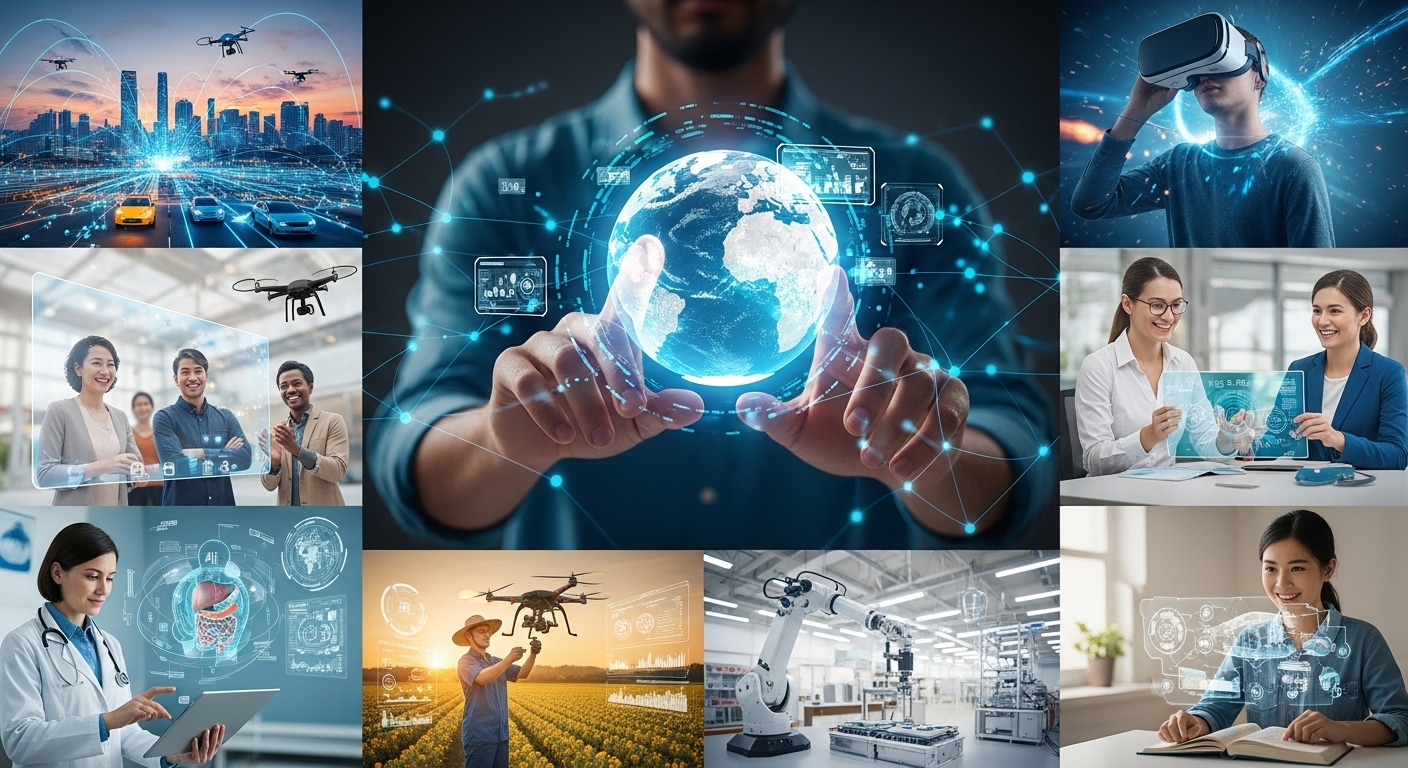
Technology has always been a driving force behind societal evolution. From the invention of the wheel to the rise of the internet, each innovation has reshaped the way humans live, work, and interact. Today, we are standing at the brink of a technological revolution that promises to redefine every aspect of human life. The convergence of artificial intelligence, biotechnology, quantum computing, and other advanced fields is creating unprecedented opportunities and challenges. This blog explores the key trends shaping the future of technology, their implications, and the potential impact on society.
Artificial Intelligence: Transforming Everyday Life
Artificial Intelligence (AI) is arguably the most transformative technology of the 21st century. Initially limited to rule-based systems, AI has evolved into advanced machine learning and deep learning algorithms capable of performing complex tasks with minimal human intervention. AI applications are now ubiquitous, powering everything from voice assistants to autonomous vehicles and sophisticated medical diagnostics.
AI is revolutionizing industries by automating repetitive tasks, enhancing decision-making, and improving efficiency. In healthcare, AI-driven diagnostic tools can analyze medical images faster and with greater accuracy than human radiologists. In finance, AI algorithms predict market trends and detect fraudulent transactions in real-time. Even in education, AI-powered personalized learning systems tailor curriculum based on individual student needs, enhancing learning outcomes.
However, AI also raises significant ethical and societal concerns. Issues such as algorithmic bias, privacy violations, and potential job displacement are critical challenges that must be addressed. As AI becomes more sophisticated, the need for ethical frameworks, transparency, and accountability grows increasingly important.
Quantum Computing: Redefining Computational Limits
Quantum computing represents a paradigm shift in the way we process information. Unlike classical computers, which rely on bits to represent 0s and 1s, quantum computers use qubits that can exist in multiple states simultaneously. This property, known as superposition, combined with entanglement, allows quantum computers to solve certain problems exponentially faster than classical machines.
The potential applications of quantum computing are staggering. In cryptography, quantum algorithms could break current encryption methods, prompting the development of quantum-resistant security protocols. In drug discovery, quantum simulations can model complex molecular interactions with unprecedented precision, accelerating the development of new treatments. Additionally, quantum computing could revolutionize optimization problems, logistics, and climate modeling.
Despite its promise, quantum computing is still in its infancy. Building stable, error-free qubits remains a significant technical challenge, and widespread commercial adoption may still be years away. However, the ongoing research and investment in this field suggest a future where quantum computing becomes an integral part of scientific and industrial processes.
The Internet of Things: Connecting the World
The Internet of Things (IoT) is creating a world where everyday objects are interconnected, collecting and exchanging data seamlessly. From smart homes to industrial automation, IoT is transforming how we interact with our environment and manage resources.
Smart devices, such as thermostats, lighting systems, and wearable health monitors, provide real-time insights into daily activities, helping individuals make informed decisions. In industrial settings, IoT sensors monitor machinery performance, predict maintenance needs, and reduce downtime, leading to increased productivity and cost savings.
However, the proliferation of connected devices also introduces cybersecurity challenges. Each device represents a potential entry point for malicious attacks, making robust security measures essential. Additionally, the sheer volume of data generated by IoT devices raises questions about data privacy, storage, and management.
Biotechnology: Shaping the Future of Health
Biotechnology is at the forefront of scientific innovation, merging biology with technology to address some of humanity’s most pressing health challenges. Advances in gene editing, synthetic biology, and regenerative medicine are opening new possibilities for treating diseases, enhancing human capabilities, and even extending lifespan.
CRISPR technology, for instance, allows scientists to modify DNA with unprecedented precision, potentially curing genetic disorders and preventing hereditary diseases. Meanwhile, personalized medicine leverages genetic information to develop tailored treatment plans, improving efficacy and reducing side effects. Regenerative medicine, including stem cell therapy and tissue engineering, promises to repair or replace damaged organs, offering hope for conditions previously deemed untreatable.
While the potential benefits are immense, biotechnology also raises ethical dilemmas. Questions about genetic modification, cloning, and the long-term impact of human enhancement require careful consideration and regulation to ensure responsible innovation.
Renewable Energy and Sustainable Technology
As the world grapples with climate change, technology is playing a pivotal role in developing sustainable solutions. Renewable energy technologies, such as solar, wind, and hydroelectric power, are reducing reliance on fossil fuels and decreasing carbon emissions. Advances in energy storage, smart grids, and energy-efficient systems are further enhancing the viability of a sustainable energy future.
Innovations in electric vehicles, smart transportation systems, and green building materials are also contributing to environmental sustainability. By integrating technology into everyday life, societies can reduce ecological footprints while maintaining economic growth and improving quality of life.
Robotics and Automation: Redefining Work
Robotics and automation are transforming industries by performing tasks that are dangerous, repetitive, or require high precision. From manufacturing assembly lines to surgical procedures, robots are enhancing productivity and safety while reducing human error.
Autonomous robots in warehouses, agriculture, and logistics are streamlining operations, cutting costs, and improving efficiency. In healthcare, surgical robots enable minimally invasive procedures with faster recovery times. Additionally, advancements in collaborative robots, or cobots, allow humans and machines to work side by side, creating new opportunities for workplace synergy.
However, the rise of robotics also raises questions about employment. As machines take over routine tasks, workers may need to adapt by acquiring new skills and transitioning to roles that require creativity, problem-solving, and emotional intelligence.
Virtual Reality and Augmented Reality: Redefining Experiences
Virtual Reality (VR) and Augmented Reality (AR) are reshaping how humans interact with digital environments. VR immerses users in entirely virtual worlds, while AR overlays digital information onto the real world. These technologies are transforming entertainment, education, training, and even therapy.
In gaming and entertainment, VR creates immersive experiences that were once unimaginable. In education, AR and VR enable interactive learning, allowing students to explore historical sites, conduct virtual experiments, and visualize complex concepts. In healthcare, VR is used for pain management, mental health therapy, and surgical training, enhancing patient outcomes and professional skills.
The expansion of VR and AR technologies promises new ways of experiencing the world, blurring the line between the physical and digital realms.
Blockchain and Decentralized Technologies
Blockchain technology, best known as the foundation of cryptocurrencies, offers more than just digital money. By providing a secure, transparent, and tamper-proof ledger, blockchain has applications in finance, supply chain management, healthcare, and governance.
Smart contracts, enabled by blockchain, automate transactions and enforce agreements without intermediaries, reducing costs and increasing efficiency. In supply chains, blockchain enhances traceability and accountability, ensuring that products meet quality and ethical standards. In healthcare, patient records can be securely stored and shared, improving care coordination and data integrity.
Decentralized technologies also have the potential to challenge traditional power structures, promoting greater transparency and democratization of information. However, scalability, energy consumption, and regulatory hurdles remain significant challenges.
Ethical and Societal Implications of Emerging Technology
As technology advances, society faces complex ethical, social, and economic questions. Issues such as data privacy, surveillance, AI ethics, and digital inequality require careful consideration. Policymakers, technologists, and citizens must collaborate to create frameworks that ensure technology serves humanity rather than undermining it.
Digital literacy and responsible technology adoption are essential to prevent misuse and promote equitable access. Additionally, fostering diversity and inclusivity in technological development can help create solutions that reflect the needs and values of a global population.
Preparing for a Technologically Advanced Future
To thrive in a future dominated by advanced technology, individuals and societies must embrace lifelong learning, adaptability, and innovation. Education systems need to focus on critical thinking, creativity, and digital skills to prepare the next generation for jobs that may not yet exist. Businesses must adopt agile strategies and ethical practices to remain competitive and socially responsible.
Governments and organizations must also prioritize research and development, invest in infrastructure, and establish regulations that balance innovation with safety, privacy, and fairness. Collaboration between public and private sectors, academia, and civil society is crucial to navigating the complexities of technological transformation.
Conclusion
The future of technology is both exciting and challenging. From AI and quantum computing to biotechnology and renewable energy, emerging innovations promise to enhance human life, solve pressing global issues, and redefine societal norms. However, these advancements also bring ethical, social, and economic responsibilities that cannot be ignored.
By fostering a culture of responsible innovation, embracing lifelong learning, and prioritizing inclusivity and sustainability, humanity can harness the power of technology to build a future that is prosperous, equitable, and resilient. The choices we make today will shape the technological landscape of tomorrow, and our ability to navigate this transformation will determine the quality of life for generations to come.