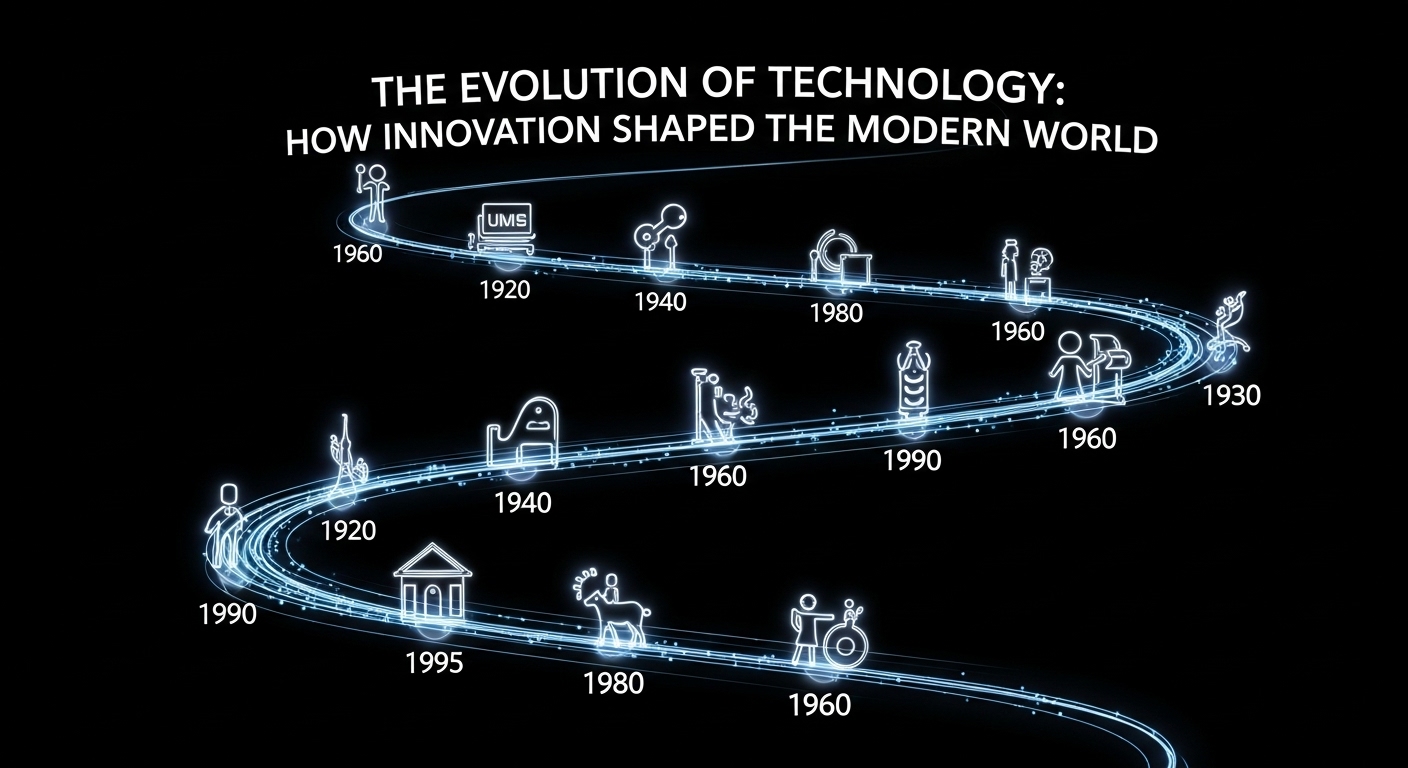
Technology is the heartbeat of modern civilization. From the hum of early machinery in the Industrial Age to the silent power of microprocessors in our pockets, humanity’s journey with technology tells a story of innovation, ambition, and transformation. It’s a narrative that stretches from the smoky factories of the 18th century to the cloud-connected devices of the 21st. In this blog, we’ll explore how technology has evolved, reshaped industries, transformed lifestyles, and continues to define the future of human progress.
The Dawn of the Industrial Age
The Industrial Revolution in the late 18th century marked the first major shift in human productivity since the advent of agriculture. Before this era, most people lived in rural areas and worked in agriculture or small-scale craftsmanship. The introduction of machines such as the spinning jenny, the steam engine, and the power loom changed everything.
These inventions mechanized labor, dramatically increasing efficiency and productivity. Steam engines allowed factories to move away from rivers and water sources, fueling the growth of urban centers. The textile, steel, and coal industries became the backbone of the global economy. For the first time, humanity experienced the power of technological innovation as a driver of social and economic change.
The Industrial Revolution didn’t just create new machines—it created new mindsets. It taught the world that innovation could replace tradition, and progress could be engineered.
The Age of Electricity and Communication
If steam powered the 19th century, electricity powered the 20th. The late 1800s saw the rise of electrical engineering, bringing light, communication, and motion to every corner of life. Thomas Edison’s light bulb illuminated cities and extended the working day. Nikola Tesla’s alternating current system made long-distance power distribution practical.
Communication was another frontier. The telegraph and later the telephone connected people like never before. Messages that once took days or weeks could be sent instantly across continents. This network of connectivity laid the foundation for the modern world.
Electricity also birthed the first wave of automation. Factories used electric motors, improving safety and productivity. Domestic life began to change too, as electric appliances—refrigerators, washing machines, and radios—entered homes, transforming daily routines.
By the early 20th century, technology was no longer confined to industrial machines; it had entered the personal sphere.
The Birth of the Computer Age
The mid-20th century ushered in the most revolutionary invention of all—the computer. Originally massive machines that filled entire rooms, early computers like ENIAC and UNIVAC were designed for military calculations and scientific research. But soon, visionaries realized their potential for business, education, and daily life.
In 1947, the invention of the transistor changed everything. Smaller, faster, and more reliable than vacuum tubes, transistors made modern computers possible. By the 1960s, computers were being used by governments, corporations, and universities.
Then came microprocessors in the 1970s. Companies like Intel created chips that condensed the power of an entire computer into a tiny silicon wafer. This made personal computers possible. In 1976, Apple introduced the Apple I, followed by the IBM PC in 1981. Suddenly, computing was no longer the privilege of large institutions—it became accessible to ordinary people.
This era marked the democratization of technology. The computer became not just a tool, but an extension of human capability.
The Rise of the Internet and the Information Age
No technological leap has reshaped the world as dramatically as the rise of the internet. Born out of ARPANET in the 1960s, the internet became commercially available in the 1990s and rapidly transformed global communication, commerce, and culture.
The World Wide Web made information instantly accessible. Email replaced letters, and websites became the new storefronts. The dot-com boom of the late 1990s showed the power and potential of digital connectivity, even if it ended in a temporary bust.
Search engines, online banking, e-commerce, and digital publishing redefined entire industries. Suddenly, a person in one corner of the world could communicate, learn, and transact with someone on the other side of the globe. The concept of distance itself began to fade.
The internet also birthed the age of data. Every click, search, and interaction created digital footprints. Information became the new currency, and companies that could harness it—like Google, Amazon, and Facebook—rose to dominate the economy.
Mobile Technology and the Age of Connectivity
If the internet made the world smaller, smartphones put it in our hands. The launch of the iPhone in 2007 marked a turning point in technological history. A single device could now function as a computer, camera, GPS, and communication hub.
Mobile technology redefined convenience. Apps became the new tools of the digital age, turning phones into platforms for entertainment, work, and social interaction. From ordering food to booking travel, from online banking to streaming movies, everything became accessible from the palm of one’s hand.
Social media also emerged as a global force. Platforms like Facebook, Twitter, Instagram, and later TikTok turned ordinary people into content creators and influencers. The world became not just connected—but constantly communicating.
This era also brought forth wearable technology, such as smartwatches and fitness trackers, blurring the line between the digital and physical realms.
Artificial Intelligence: Machines That Learn
Artificial Intelligence (AI) represents the next major leap in technological evolution. What began as theoretical computer science in the mid-20th century is now a reality that powers nearly every digital system.
AI enables machines to analyze data, recognize patterns, and make decisions—tasks once thought to require human intelligence. Machine learning, deep learning, and neural networks have allowed AI to excel at speech recognition, image processing, and predictive analytics.
From voice assistants like Siri and Alexa to recommendation systems on streaming platforms, AI is woven into everyday life. In healthcare, it helps detect diseases; in finance, it prevents fraud; in logistics, it optimizes supply chains.
AI also powers self-driving cars, autonomous drones, and robotic manufacturing systems. It’s not just about automation—it’s about augmentation, extending human abilities in unprecedented ways.
But with great power comes great responsibility. The ethical implications of AI—bias, privacy, and employment disruption—have sparked global discussions about how technology should serve humanity, not replace it.
The Cloud and the Power of Virtual Infrastructure
The next frontier of innovation emerged quietly but profoundly: cloud computing. Instead of relying on physical servers and storage, businesses and individuals began using virtual infrastructure hosted remotely.
Cloud computing made data accessible anywhere, anytime. It allowed companies to scale rapidly, without massive investments in hardware. Software-as-a-Service (SaaS) platforms like Zoom, Google Workspace, and Salesforce became essential tools for modern work.
The cloud also enabled remote collaboration, which proved critical during the global shift to remote work. Teams could share, edit, and store documents seamlessly, breaking down geographical barriers in the workplace.
For individuals, cloud storage offered convenience and safety. Photos, documents, and backups could be stored securely without fear of hardware failure. This invisible infrastructure quietly supports nearly every digital service we use today.
The Internet of Things (IoT): A Connected World
Imagine waking up to a home that adjusts its temperature automatically, brews your coffee, and tells you the weather before you step outside. This is the world of the Internet of Things (IoT)—where everyday objects are embedded with sensors and connected to the internet.
IoT has transformed industries from manufacturing to agriculture. Smart factories use sensors to monitor equipment and prevent breakdowns. Farmers use connected devices to track soil health, weather patterns, and crop growth.
In cities, IoT powers “smart city” initiatives—managing traffic, energy use, and waste more efficiently. In healthcare, wearable devices monitor vital signs and alert doctors in real time.
IoT brings convenience and efficiency, but also raises concerns about data privacy and security. Every connected device becomes a potential entry point for cyberattacks, making cybersecurity more critical than ever.
Cybersecurity in the Digital Age
As technology advances, so do the threats that accompany it. Cybersecurity has become one of the most pressing issues of the 21st century.
With vast amounts of personal and corporate data stored online, hackers have more opportunities than ever to exploit vulnerabilities. Data breaches, ransomware attacks, and identity theft are now common challenges faced by individuals and organizations alike.
The rise of artificial intelligence in cyber defense has helped detect threats faster, but it has also given cybercriminals new tools. The digital battlefield is constantly evolving, requiring constant vigilance, education, and innovation.
Governments and corporations have begun implementing stricter data protection laws and frameworks to ensure security and privacy in the digital age.
The Rise of Blockchain and Decentralization
Blockchain technology, introduced through Bitcoin in 2009, has since evolved beyond cryptocurrency. At its core, blockchain is a distributed ledger that records transactions securely and transparently without the need for central authority.
This decentralization has massive implications. Beyond finance, blockchain is being used in supply chain management, digital identity verification, and even voting systems.
It offers transparency, traceability, and trust in a digital world often plagued by manipulation and data breaches. While cryptocurrency remains the most famous application, the underlying technology has far broader potential.
The Age of Automation and Robotics
Automation is no longer confined to assembly lines. Intelligent robots are now performing complex tasks—from surgery to customer service.
Industrial robots have revolutionized manufacturing, increasing precision and productivity. Service robots handle deliveries, cleaning, and even companionship for the elderly.
The future of robotics lies in collaboration. “Cobots,” or collaborative robots, work alongside humans, enhancing rather than replacing them. This human-robot synergy represents a new era of partnership between biology and technology.
Biotechnology and the Merging of Life and Tech
One of the most profound frontiers of modern technology is biotechnology—the merging of biology and engineering. Advances in gene editing, such as CRISPR, have made it possible to modify DNA with precision.
From personalized medicine to lab-grown organs, biotechnology is redefining healthcare. Wearable biosensors and digital health platforms empower individuals to track and manage their wellness in real time.
Beyond medicine, bioengineering has applications in agriculture, energy, and environmental sustainability. Scientists are creating biofuels, biodegradable plastics, and even synthetic organisms to address global challenges.
This convergence of tech and biology raises deep ethical questions, but also offers immense promise for improving the quality of life.
Quantum Computing: The Next Frontier
While classical computers use bits, quantum computers use qubits—units that can exist in multiple states simultaneously. This allows them to process information at speeds unimaginable by today’s standards.
Quantum computing could revolutionize industries such as cryptography, pharmaceuticals, and artificial intelligence. It holds the potential to solve problems that are currently computationally impossible, like simulating complex molecules for new drug discoveries.
Although still in its early stages, quantum computing represents the next great leap in human technological evolution—one that could reshape our understanding of computation itself.
The Human Side of Technology
While technology has advanced rapidly, its impact on humanity is complex. It has brought unprecedented convenience, connectivity, and opportunity—but also new challenges.
Digital addiction, privacy concerns, job displacement, and misinformation are pressing issues in our hyperconnected world. Technology amplifies human potential, but also human flaws.
The challenge ahead is not just to innovate, but to innovate responsibly—to ensure that technology serves as a tool for progress rather than a source of division or control.
Education, ethics, and digital literacy will be key in navigating this landscape. Technology should enhance humanity, not overshadow it.
The Future of Technology: What Lies Ahead
Looking ahead, the future of technology promises even more transformation. Artificial intelligence will become more integrated, capable of understanding emotions and creativity.
The metaverse will merge digital and physical experiences, creating new ways to interact, work, and play. Space exploration, powered by private companies, may soon make interplanetary travel a reality.
Sustainable technology will also play a vital role. From renewable energy to circular economies, innovation will be directed toward preserving the planet.
Ultimately, the future of technology will be defined not by machines—but by how we choose to use them. The human spirit of curiosity and creativity remains the driving force behind every invention.
Conclusion
The story of technology is the story of humanity itself—a tale of progress, adaptation, and endless curiosity. From the clatter of the first looms to the silent hum of quantum processors, we’ve come a long way.
Each technological era builds upon the last, shaping how we live, work, and think. The tools we create, in turn, reshape us.
As we stand on the threshold of new frontiers—AI, biotechnology, quantum computing, and beyond—we must remember that technology is not destiny. It is a reflection of our choices, values, and vision for the future.
The question is not whether technology will evolve, but whether we will evolve with it—wisely, ethically, and inclusively. The future is being built now, one innovation at a time.