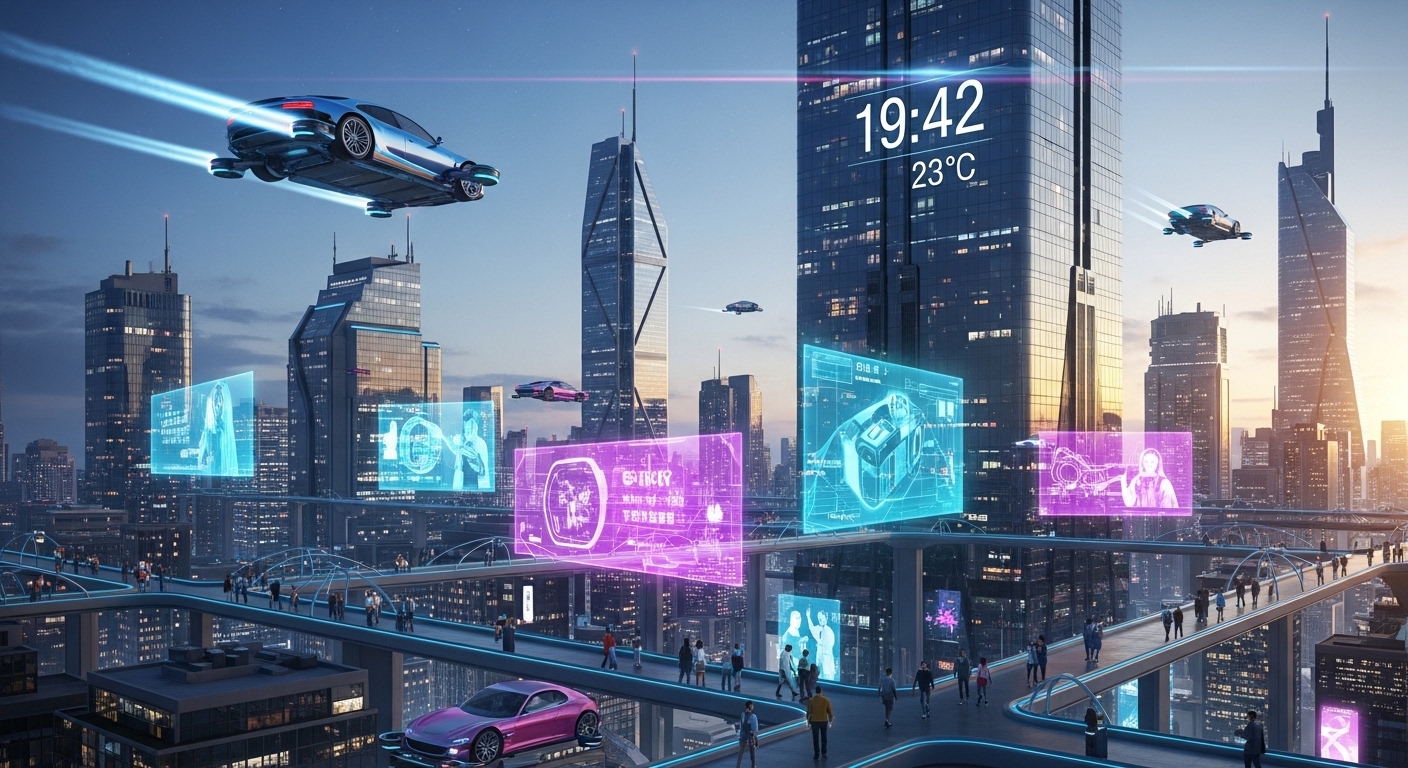

Technology has continuously transformed our world, from the industrial revolution to the rise of the internet. However, the next decade promises to be even more revolutionary as we witness groundbreaking advancements that will alter how we live, work, and interact with the world around us. In this blog post, we will explore key technological trends and innovations that are expected to shape the future of various industries and society as a whole.
1. Artificial Intelligence: The Brain Behind Tomorrow’s World
Artificial Intelligence (AI) is no longer a concept confined to science fiction. It is a driving force in industries across the globe, and its potential is only beginning to be realized. AI is expected to be at the heart of many innovations in the coming decade, influencing everything from healthcare and manufacturing to entertainment and transportation.
1.1 AI in Healthcare
AI’s ability to process and analyze vast amounts of data in seconds allows it to revolutionize healthcare. Machine learning algorithms can predict patient outcomes, assist in diagnosing diseases, and even identify new drug candidates. Moreover, AI-powered robotics and automation will help streamline surgeries and other medical procedures, increasing precision and reducing human error.
AI is also set to change the way we approach personalized medicine. With the help of AI, healthcare providers will be able to tailor treatments based on a patient’s genetic profile, lifestyle, and medical history, leading to more effective and targeted care.
1.2 AI in Automation and Industry
The rise of AI will lead to further automation of manual and repetitive tasks, particularly in manufacturing, logistics, and service industries. Robotic Process Automation (RPA) is already being used to handle tasks such as data entry, customer service, and supply chain management, which allows businesses to cut costs and increase efficiency.
Industries will see a shift toward autonomous systems, with AI running everything from delivery drones and self-driving vehicles to supply chain management and inventory control. This shift could result in mass layoffs for certain job categories but will create new roles that focus on AI development, implementation, and ethical considerations.
2. Blockchain and Decentralized Technologies: Redefining Trust
Blockchain technology is perhaps best known for its association with cryptocurrency, but its uses extend far beyond digital currencies. Blockchain’s core feature – decentralization – is being harnessed to create secure, transparent, and immutable systems that could reshape various industries.
2.1 Blockchain in Finance and Cryptocurrencies
Blockchain’s most popular application remains in the financial sector, where it facilitates secure, peer-to-peer transactions without the need for an intermediary like a bank. Cryptocurrencies like Bitcoin, Ethereum, and newer tokens offer an alternative to traditional banking systems, allowing for global financial transactions with lower fees and increased privacy.
However, the future of blockchain in finance goes beyond digital currencies. Central banks worldwide are exploring the concept of Central Bank Digital Currencies (CBDCs), which would leverage blockchain to create a secure, government-backed form of digital money. This could enhance financial inclusion, streamline payment systems, and reduce the risks of fraud and cybercrime.
2.2 Blockchain in Supply Chain and Smart Contracts
Blockchain is also making waves in supply chain management. By using blockchain, companies can trace the origin of products from raw materials to final delivery, ensuring transparency and accountability. This is especially valuable in industries like food, pharmaceuticals, and luxury goods, where provenance and authenticity are critical.
Moreover, the concept of smart contracts, which are self-executing contracts with the terms of the agreement directly written into code, is gaining traction. These contracts could automate everything from business transactions to legal agreements, reducing administrative overhead and minimizing the potential for disputes.
3. Quantum Computing: Unlocking the Power of the Future
Quantum computing is poised to revolutionize industries that rely on complex computations, such as pharmaceuticals, finance, logistics, and cybersecurity. Unlike classical computers that process information in binary form (0s and 1s), quantum computers use quantum bits or qubits, which can exist in multiple states simultaneously. This allows quantum computers to perform calculations at speeds that are exponentially faster than traditional computers.
3.1 Quantum Computing in Research and Development
The implications of quantum computing in research are immense. In fields such as drug discovery, researchers could use quantum computers to simulate complex molecular structures and chemical reactions, dramatically speeding up the process of discovering new drugs. In finance, quantum computing could be used to optimize trading strategies, reduce risk, and create new financial models.
Additionally, quantum computing can play a significant role in solving optimization problems, such as route planning and resource allocation, which have far-reaching applications in logistics, manufacturing, and energy distribution.
3.2 Quantum Computing and Cybersecurity
Cybersecurity is another area that will see significant change with the advent of quantum computing. While quantum computers could potentially break current encryption methods, they also offer the ability to create more secure encryption protocols. Quantum cryptography uses the principles of quantum mechanics to create unbreakable encryption, ensuring that sensitive data remains protected in a quantum-powered world.
4. 5G Networks: Accelerating Connectivity
The rollout of 5G networks is one of the most anticipated technological developments in the coming years. With download speeds up to 100 times faster than current 4G networks, 5G promises to revolutionize the way we connect to the internet and interact with our devices.
4.1 The Impact of 5G on the Internet of Things (IoT)
5G’s low latency and high bandwidth are essential for the proliferation of the Internet of Things (IoT). With the ability to connect billions of devices in real-time, 5G will enable smart homes, cities, and factories, where everything from appliances and vehicles to infrastructure and utilities are connected and automated. This will lead to significant improvements in energy efficiency, resource management, and overall quality of life.
4.2 5G in Autonomous Vehicles and Smart Cities
The real-time communication enabled by 5G is crucial for the development of autonomous vehicles. Self-driving cars need to exchange large amounts of data with other vehicles, traffic lights, and infrastructure to operate safely. With the ultra-low latency of 5G, these vehicles will be able to respond to changes in their environment almost instantaneously, reducing the risk of accidents.
In smart cities, 5G will enable seamless communication between everything from streetlights and waste management systems to public transportation and emergency services. This will improve urban living, making cities more efficient, sustainable, and responsive to the needs of their residents.
5. Virtual Reality and Augmented Reality: Redefining Interaction
Virtual Reality (VR) and Augmented Reality (AR) are two technologies that have the potential to transform entertainment, education, healthcare, and more. While VR creates immersive, digital environments that users can interact with, AR overlays digital information onto the real world, enhancing our physical surroundings with additional context.
5.1 VR and AR in Education and Training
VR and AR are already making waves in education and training. VR allows students to experience lessons in immersive environments, whether it’s walking through ancient civilizations or exploring the human body at a microscopic level. AR, on the other hand, can enhance traditional classroom learning by overlaying digital content onto textbooks or lab equipment, providing interactive and engaging lessons.
For professionals, VR and AR are being used in fields such as medicine, engineering, and the military for training simulations. Surgeons can practice complex procedures in a VR environment, while soldiers can prepare for combat scenarios using AR-based simulations. These technologies provide a safe, cost-effective, and highly engaging way to hone critical skills.
5.2 VR and AR in Entertainment and Retail
In the entertainment industry, VR is enabling new forms of gaming, where players can physically immerse themselves in the game world. Additionally, VR is being used for virtual concerts, events, and movie experiences, providing fans with new, interactive ways to engage with content.
In retail, AR allows customers to visualize products in their real-world environment before making a purchase. For example, furniture stores are using AR apps to help customers see how a piece of furniture will look in their home, while fashion retailers are experimenting with virtual try-ons to give customers a better sense of how clothing will fit.
6. Renewable Energy and Green Technologies: The Push for Sustainability
As the world grapples with climate change, there is a growing push toward renewable energy and green technologies. The next decade will see significant advancements in solar, wind, and battery technologies, as well as the widespread adoption of electric vehicles (EVs) and smart grids.
6.1 Solar and Wind Energy Innovations
Solar power is becoming increasingly efficient and affordable, thanks to advancements in photovoltaic materials and manufacturing techniques. Likewise, wind energy is seeing improvements in turbine design, enabling larger, more efficient wind farms. These developments will help accelerate the transition to a renewable energy future.
6.2 Electric Vehicles and Smart Grids
Electric vehicles (EVs) are set to dominate the roads in the next decade, with more affordable models, longer ranges, and faster charging times. The rise of EVs will be complemented by the expansion of charging infrastructure and the integration of smart grids, which allow for real-time monitoring and optimization of energy usage across entire cities and regions.
Conclusion: A Technological Renaissance
The next decade promises to be a period of unprecedented technological growth. With advancements in AI, blockchain, quantum computing, 5G, and many other fields, we are on the verge of a technological renaissance that will shape the future of humanity. While these innovations bring immense opportunities, they also come with challenges related to ethics, privacy, and workforce displacement. The future will require a balanced approach that fosters innovation while ensuring that technology serves the greater good of society.